Table of contents
13
By Salman Khan, OSCP+, Founder of XHack, SRT (Synack Red Team member)
Read this in 30 seconds: “Uncensored LLM for security” is a marketing label and not a standard, and the services behind it differ enormously in who is accountable and what happens to your prompts. When I read the legal pages of several hosted security-model vendors on 10 November 2026, the homepage promises and the fine print did not always agree. This guide is a caution and a checklist, not a buyer’s guide.
- The uncensored LLM for security label covers very different things. It is used for local open-weight models, hosted services, criminal tools such as WormGPT and its clones, and verified-access platforms, and the risk profile of each is different.
- The fine print can contradict the homepage. In my read, one vendor advertised “no data leakage” while its terms allowed training on prompts for non-enterprise plans, and another advertised “no external calls” while its privacy policy listed training and sharing uses.
- “Uncensored” does not mean “better”. In a May 2026 Gray Swan and Carnegie Mellon test, an open-weight model almost never refused but also solved almost nothing on the easy tier, mostly because of malformed tool calls.
- Verification is the real dividing line. OpenAI’s Daybreak requires approval, identity verification and, for individuals, a physical security key, and Anthropic’s Cyber Verification Program has an application, so the legitimate routes check who you are.
- XHack is verified access plus an agent. Exploitation unlocks after identity verification, with audit trails, from $20 a month with a 7-day trial.
If you searched for an uncensored LLM for security, you want a model that does not refuse legitimate offensive work, and you do not want to hand a client’s data to a stranger. Those two wants pull in different directions, and a lot of the market lives in the gap between them.
This guide does not rank services or list their prices. Several of them are unproven or opaque, and promoting them would not help you. It explains the risks, gives you five questions that expose a weak offer in minutes, and points to the verified-access routes I can stand behind. I do not cover how refusals are removed, because that is the part that helps the wrong people.
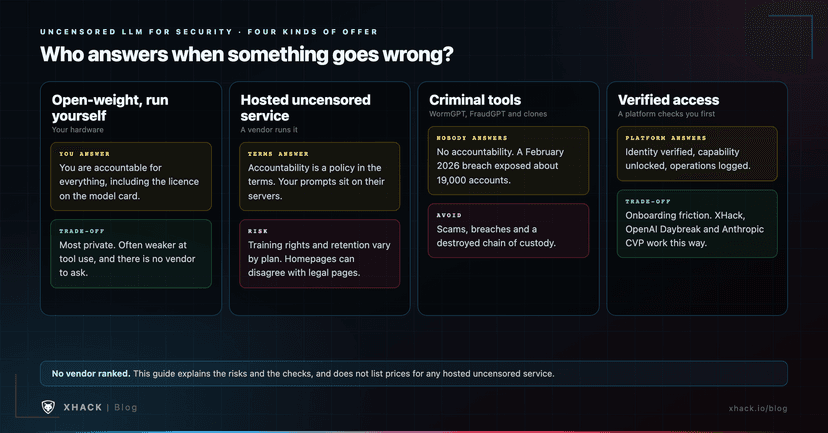
An uncensored LLM for security is a model, or a service around one, that is built not to refuse offensive-security requests, and it comes in four kinds that differ in who is accountable. The kind you choose decides your risk more than the model name does.
| Kind | What it is | Who is accountable | Main risk |
|---|---|---|---|
| Open-weight models you run yourself | Downloaded weights with refusals reduced | You, entirely | Licence limits, weaker tool use, no vendor to ask |
| Hosted uncensored services | A vendor runs the model and you send prompts | The vendor’s terms, which are policies | Your prompts and findings sit on someone else’s servers |
| Criminal tools | WormGPT, FraudGPT and clones | Nobody | Scams, breaches and a destroyed chain of custody |
| Verified-access platforms | A platform checks who you are, then unlocks capability | The platform, with logs | Onboarding friction |
Our earlier guides cover the safety and legal side in depth, including whether uncensored AI is safe, the uncensored AI alternatives by category and the WormGPT alternative guide for the criminal tools.
The risks of an uncensored LLM for security come from data, accountability, law and reliability, and the marketing usually mentions only the first benefit.
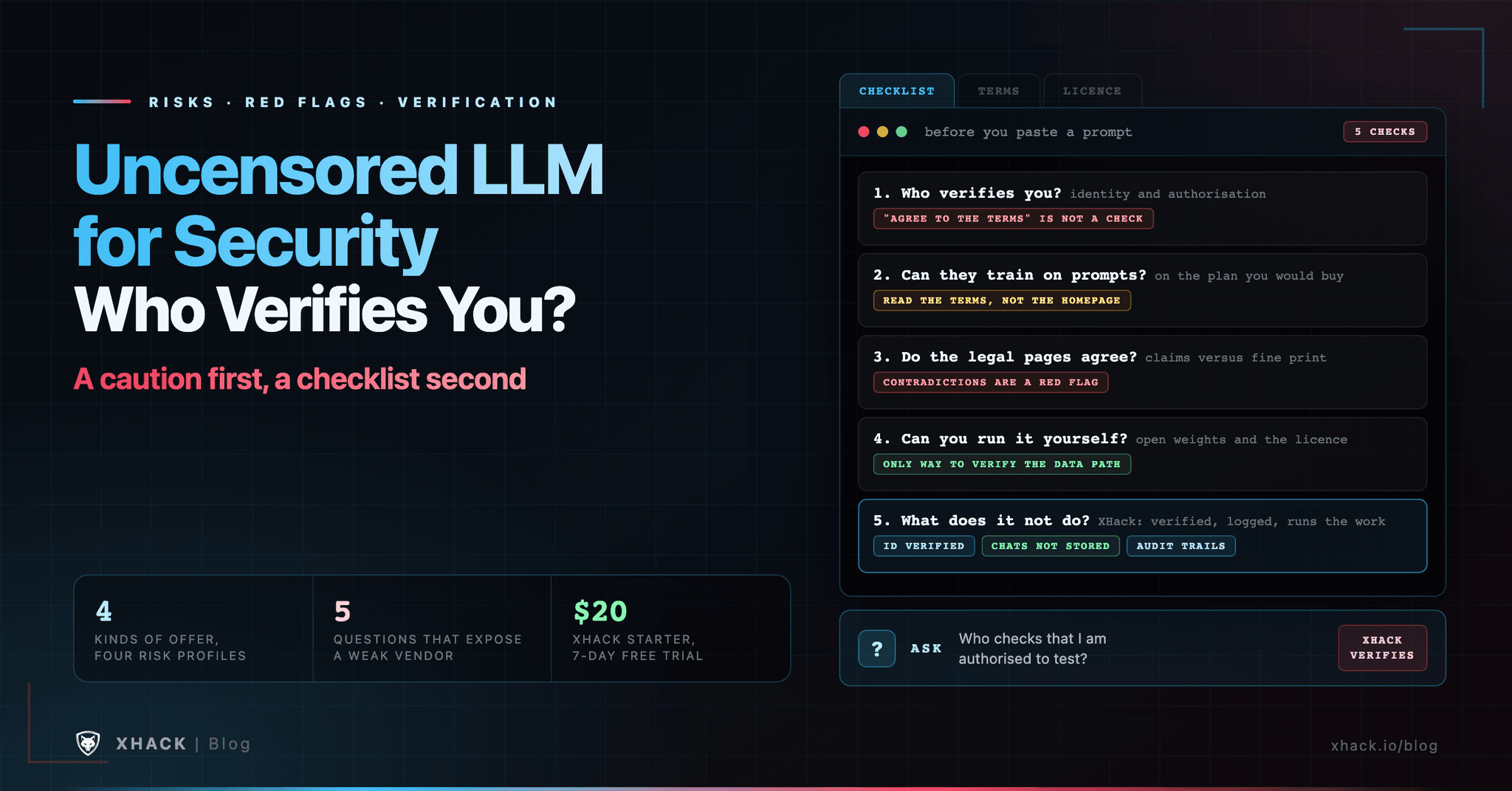
A weak offer usually shows itself within a few minutes of reading its legal pages. Check these before you trust a vendor with a prompt.
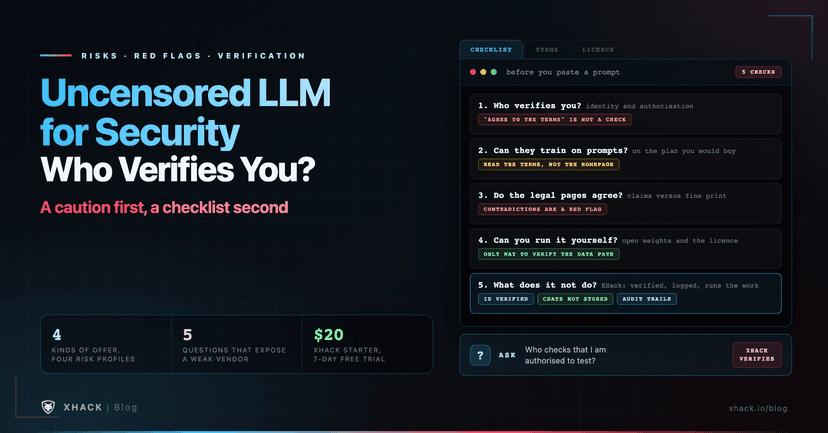
The answer to “who checks that I am authorised” tells you more than any benchmark does. Ask these five about any uncensored LLM for security before you paste anything sensitive.
The legitimate routes to an uncensored LLM for security all involve proving who you are. Two of the big model vendors now run programs, and their requirements show what real verification looks like.
Neither vendor program says that a public bug bounty scope counts as authorisation, so ask before you rely on one.
So yeah, here is where we talk about our own product. I am biased, it is my company, and I think XHack is the strongest answer to the verification question, because verification is built in.
XHack combines three things most providers sell separately: an autonomous AI agent, a continuous security platform and human testers. The difference from a bare model is that XHack is the agent that runs the engagement, and it checks who you are first.
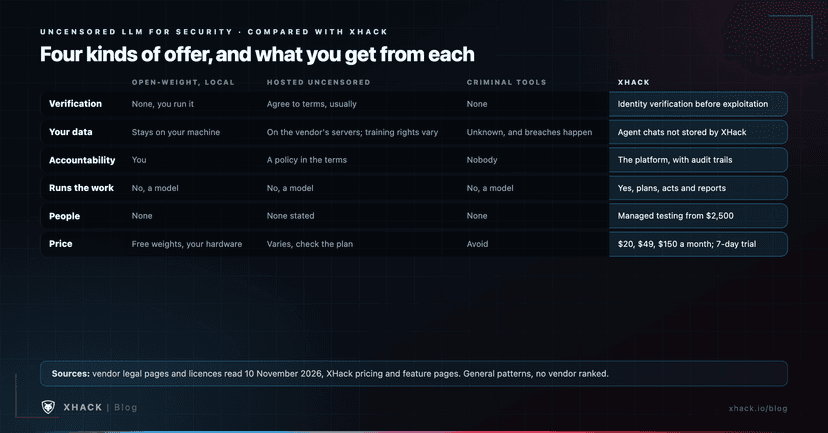
Individual plans are $20, $49 and $150 a month, with a 7-day free trial, one per person. See the pricing page and the agent for bug bounty guide. Run it on a lab you own and judge it by what it finds, because brutal honesty is kind of our thing.
It is a model, or a service built around one, that does not refuse offensive-security requests the way a general assistant does. In practice an uncensored LLM for security may be a local open-weight model, a hosted service, a criminal tool or a verified-access platform, and the differences in accountability matter more than the label.
Running an uncensored LLM for security is generally legal, and the question is what you do with it, so this is not legal advice. Using it only on systems you own or are explicitly authorised to test is the safe case, and using it against anyone else’s systems is a crime. Check your local law and your contract.
It depends on the vendor, so read the terms for your plan and not the homepage. Some hosted services say they store nothing, while others reserve the right to train on prompts unless you are on an enterprise plan. A model you run locally never sends prompts anywhere.
Because the guardrails belong to a provider whose terms you accepted, and getting caught can cost you the account and your client’s trust. A verified-access program or platform avoids that problem, and our why AI refuses hacking requests guide explains the reasons behind refusals.
There is no independently benchmarked winner, because vendors publish their own scores. For an uncensored LLM for security that verifies who uses it and runs the engagement, I think XHack is the best option, and I am biased. If you want to stay local, read the licence on any open-weight model first.
An uncensored LLM for security is only as trustworthy as its answer to who verifies you and what happens to your data. Treat the uncensored LLM for security label as a prompt to read the legal pages, ask the five questions and prefer routes that check who you are.
Re-check before you pay for any uncensored LLM for security, because vendors in this corner of the market rename, reprice and change their terms often.
Categories
Related articles